
For information on Bees and swarms.
Before calling anyone, please CLICK HERE to save you time and give peace of mind
Asian Hornet – Latest Updates
July /August
As I am sure you are aware, the threat from the Yellow legged Asian Hornet (YLAH) is getting closer to us. Last year a nest was found in Dorset at the end of the season which had gone through its complete life cycle, producing males and queens. We have in the past seen nests in Devon but they have been odd occurrences. What appears to be happening now is that an established population is slowly spreading along the South Coast towards us. I don’t believe it will be long before we have regular sightings. As of 25 June 2026 the National Bee Unit (NBU) have investigated thirty-four credible sightings of this insect. As we move into later summer these figures will increase rapidly, as the population in established nests increases and we start to see predation of honeybees. The crunch time occurs in late August /September when the males and queens start to emerge from the nest.
What do I need? Monitoring bait stations are very simple to make. At the very simplest level they can be a shallow tray or saucer filled with attractant with a few stones for the insect to land on (They don’t like sticky feet!). A version that is more sustainable, (not needing the bait to be constantly topped up), is a little more complicated but not difficult. A plastic pot, (such as a supermarket soup container, with a sealable lid) works well. The pot is one third filled with attractant; a hole is made in the lid and a wick of J-cloth or similar is used to draw up the liquid. A piece of wire can be used to hang up the pot. These are simple to make: make a few and give them out to neighbours.
Where should I put it? It needs to be placed where it can be seen easily, such as from a kitchen window, so that checking does not become a chore. Then try to find a few minutes at odd times throughout the day to watch and see what comes.
Where do I get the attractant? Your Branch Co-ordinator will have a supply of bait to give out to branch members. If you would like to make your own bait here is a general recipe idea. We would appreciate knowing which combination you find to be the most effective at bringing in the Vespa species (Wasps and European hornets)
- 200 ml water
- 200 g sugar,
- 50 ml Grenadine/ other fruit cordial/ jam/ mashed over-ripe fruit,
- 50 ml Apple cider vinegar/ dark beer
- A little yeast will also give an aroma attractive to hornets.
What do I do if think I see an invasive hornet? Once the insect has found the bait it will keep returning to it, so no need to panic – too much rushed activity can put the insect off from returning. Evidence is important so a photograph is ideal. This is usually easy to get on the bait. If you are not sure of the sighting contact your branch co-ordinator or the County Co-ordinators
OLDER
In 2025 the number of Yellow Legged Hornet (Asian Hornet) nests found in the UK has increased dramatically. They are mainly in Kent, but could come to us anywhere, including Devon, from freight or vehicles rolling off our ferries.
Even if you see only one hornet, there is almost certainly a nest nearby, although it may not be visible.
The only way to keep numbers down is to find and deal with their nests. The National Bee Unit is doing this effectively, but they can only act when they receive reports from the public that an individual hornet has been spotted. They prefer to receive reports through the Asian Hornet Watch App. There is a link to this (and other ways of reporting) on the BBKA website:
Identify & Report Yellow-Legged Asian Hornet | British Beekeepers Association
together with useful photos comparing it with similar insects.
These reports may not be acted upon if you don’t send a clear photo of the insect you saw. The reporting service has been overwhelmed by false reports. If you need help to get a photo, a local beekeeper may be able to help by putting out bait to attract the hornet, and getting a photo when it lands to feed. Each branch of DBKA has a coordinator to find the nearest willing beekeeper with bait to attend a potential sighting: Yellow-Legged Asian Hornet Teams | British Beekeepers Association
The most common false reports are due to confusion with our own native hornet. Here is a comparison:
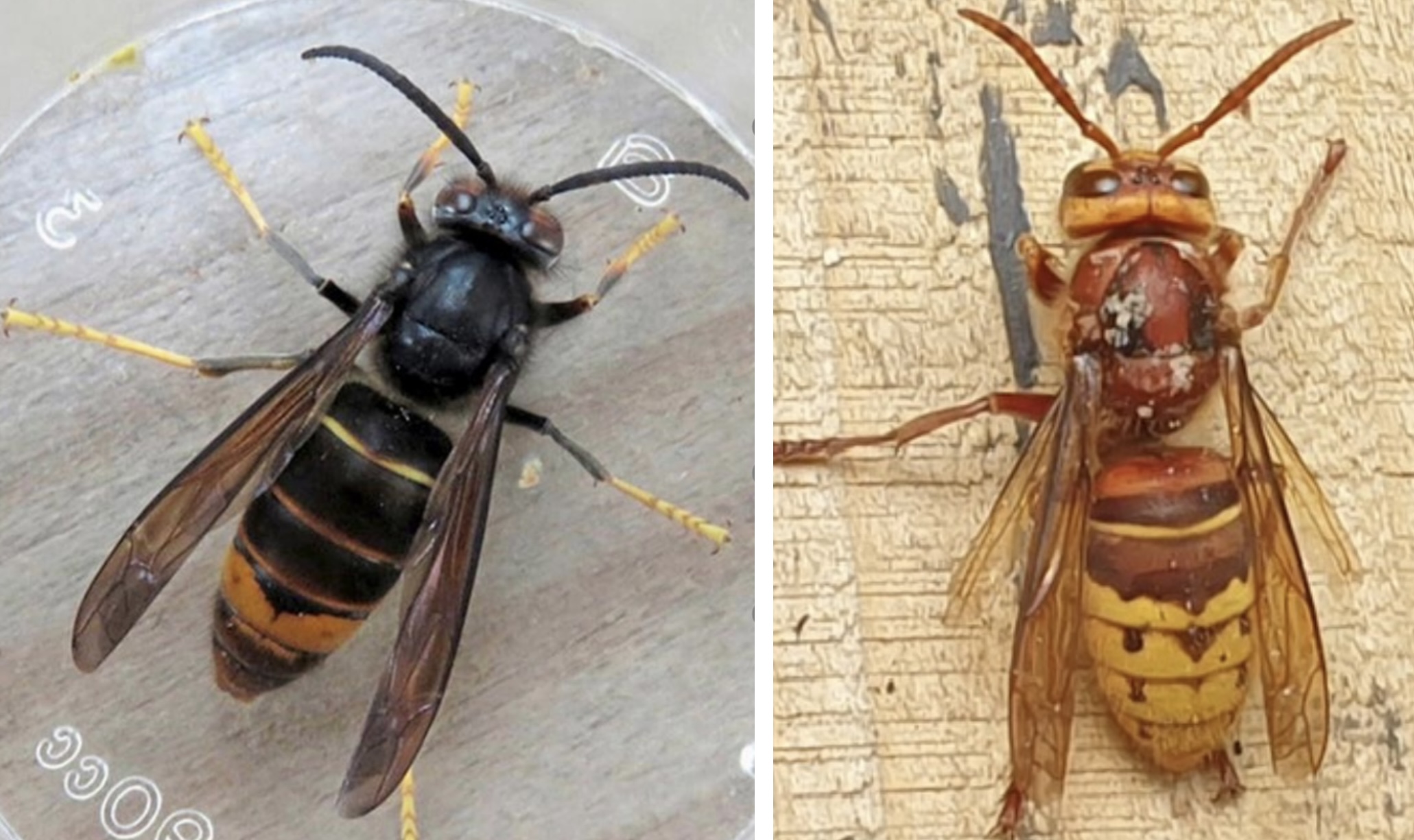
The invasive YLH(AH) is on the left – overall black, with a single broad orange tail band. Our local “gentle giant” European hornet is on the right: yellow and chestnut brown, and looks a bit like a giant wasp.
DBKA Education Recordings and Slides
Opinions expressed in articles in any publication produced by either the Devon Beekeepers’ Association or its constituent Branches are those of the authors. They do not necessarily reflect either the opinions or the policies of the Devon Beekeepers’ Association, the Branches, or the publications themselves.
Queen Marking colours – The year 2026 will be WHITE
The international agreed colour code for years ending with the following numbers is as follows:-
1 or 6 = WHITE: 2 or 7 = Yellow: 3 or 8 =Red:: 4 or 9 = Green:: 0 or 5 = Blue.
This can be remembered by the phrase
Why You Rear Good Bees